
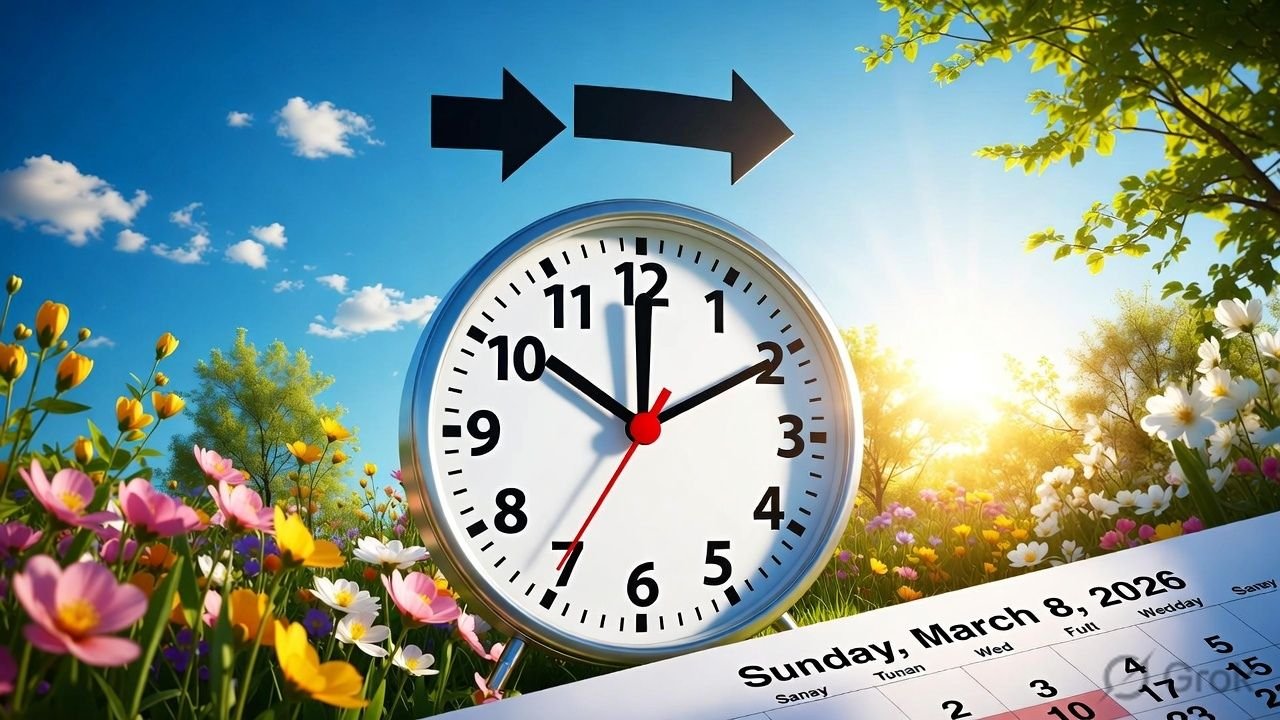
Every year, around the end of March, many countries around the world observe a significant change—changing their clocks. This process is called Daylight Saving Time (DST). Its primary purpose is to make better use of natural evening light during the summer. As the days begin to lengthen, the clocks are advanced by one hour so that people can take advantage of natural light into the late evening.
This time change will take effect in the year 2026 in the United States, Canada, the United Kingdom, and most of Europe. However, this system is not implemented in every country in the world. In many countries and regions, people observe the same time year-round and do not need to change their clocks.
When will the time change in the United States and Canada?
Daylight Saving Time will begin in most parts of the United States and Canada on Sunday, March 8, 2026, at 2 a.m. local time. At this time, clocks will be set forward one hour. This means people will get one less hour of sleep that day because time suddenly jumps forward.
This arrangement will last throughout the summer season. Then, at 2 a.m. on November 1, 2026, clocks will be set back one hour again. This process is commonly referred to as “fallback.” People get an extra hour of sleep on this day.
However, not all U.S. states follow this system. Daylight Saving Time is not implemented in Hawaii and most parts of Arizona. Interestingly, the Navajo Nation in Arizona does follow this rule. Some regions in Canada, such as British Columbia, Nunavut, Ontario, Quebec, and parts of Saskatchewan, remain outside this system.
Time Changes in the United Kingdom and Europe
Daylight Saving Time begins slightly later in the United Kingdom and most European countries. In 2026, it will come into effect on Sunday, March 29th. On that day, clocks will be set forward one hour at 01:00 UTC (or approximately 02:00 CET).
This time arrangement lasts throughout the summer and ends on October 25, 2026, when clocks are set back one hour again. British Summer Time (BST) is in effect in the United Kingdom from March to October, and after October, the country returns to Greenwich Mean Time (GMT).
However, not all European countries follow this system. For example, countries like Belarus, Iceland, and Russia do not use daylight saving time.
Why was daylight saving time introduced?

The concept of Daylight Saving Time was inspired by the idea that summer days are longer and there’s more natural light available in the evenings. If clocks were set forward one hour, people could make more use of this extra light in the evenings.
It was initially believed that this would save electricity and reduce energy consumption. However, several recent studies have questioned how much energy it actually saves.
Proponents of this system say that the extra evening light promotes business, tourism, and outdoor activities. Opponents argue that the sudden time change affects sleep patterns and may even negatively impact some people’s health.
When will spring begin in 2026?
Meteorological Spring is considered to occur from March 1st to May 31st each year. This period helps meteorologists analyze weather patterns.
Astronomically, spring begins with the Vernal Equinox. In 2026, it will fall on March 20th. The Summer Solstice, which occurs on June 21, 2026, marks the end of spring and the beginning of summer.
Conclusion
In short, Daylight Saving Time is a time-adjustment system used in many countries around the world to advance and set clocks back twice a year. Its purpose is to make better use of natural light. Although its advantages and disadvantages remain debated, many countries still follow this system, adjusting their clocks twice each year.
FAQs
1. What is Daylight Saving Time (DST)?
Daylight Saving Time is a system where clocks are moved forward by one hour during warmer months to make better use of evening daylight.
2. When does Daylight Saving Time start in the U.S. and Canada in 2026?
It begins on Sunday, March 8, 2026, at 2:00 a.m. local time, when clocks move one hour forward.
3. When does Daylight Saving Time start in the UK and Europe in 2026?
In the UK and most European countries, DST starts on Sunday, March 29, 2026.
4. Do all countries follow Daylight Saving Time?
No. Several countries and regions, including Hawaii, most of Arizona, Iceland, Russia, and Belarus, do not observe DST.
5. Why was Daylight Saving Time created?
DST was introduced to make better use of natural daylight in the evening and to potentially save energy.