
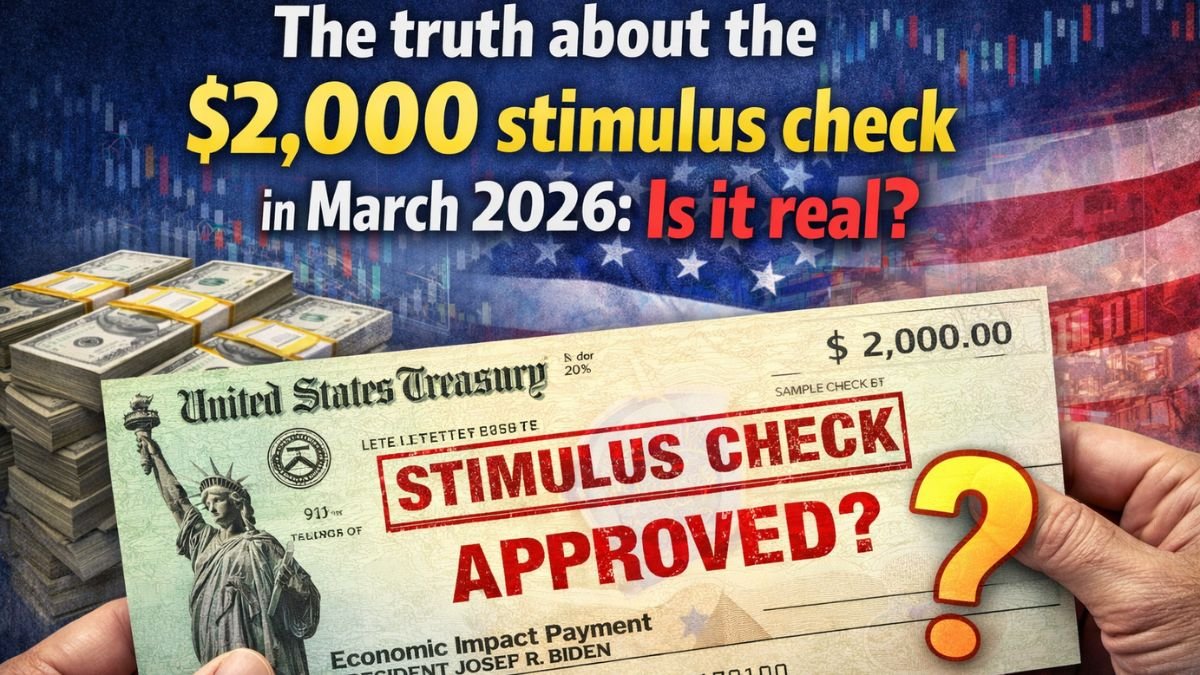
In recent months, millions of Americans have been searching online for information about a possible $2,000 stimulus check in March 2026. Social media posts, viral videos, and clickbait headlines have fueled speculation that the U.S. government is preparing to send a large financial payment to citizens to help with rising living costs and economic uncertainty. Many people hope that such a payment could provide relief from inflation, housing costs, and everyday expenses.
The idea of stimulus checks is not new. During the COVID-19 pandemic, the federal government issued several rounds of direct payments to help households cope with economic disruption. These payments became known as Economic Impact Payments, and they were distributed through the Internal Revenue Service (IRS). Because those checks helped millions of people, rumors about new payments continue to circulate whenever economic challenges arise.
However, when examining the claims about a $2,000 stimulus check in March 2026, it becomes important to separate speculation from confirmed facts. While the idea has generated excitement online, the actual status of such a payment is far more complicated.
Where the $2,000 Stimulus Check Rumor Started
The discussion around a potential $2,000 stimulus check largely stems from political proposals and economic policy debates. Some policymakers have suggested sending direct payments to Americans as a way to return government revenue or stimulate economic activity. One widely discussed concept involved using tariff revenue collected from imported goods and redistributing a portion of that money back to citizens as a form of economic dividend.
Supporters of the idea argue that such payments could help middle- and lower-income families manage rising costs and strengthen consumer spending. If implemented, they believe it could act as a financial boost similar to earlier stimulus programs.
However, a proposal alone does not mean a payment is guaranteed. In the United States, any large federal payment program requires legislation from Congress before it can become reality. Without a bill being passed and signed into law, the IRS does not have the authority to distribute stimulus checks.
As of early 2026, the proposal for a $2,000 payment remains part of policy discussions rather than an officially approved program.
What the Government and IRS Actually Say
According to the latest available information, there is no approved federal stimulus check scheduled for March 2026. Neither Congress nor the IRS has confirmed a nationwide payment program that would send $2,000 to Americans this year.
The IRS has also clarified that the pandemic-era stimulus programs ended several years ago. The last official Economic Impact Payments were issued in 2021, and no new nationwide relief checks have been authorized since then.
For a new stimulus payment to occur, Congress would need to pass a new law allocating funds and defining eligibility criteria. That process usually involves extensive debate, budgeting decisions, and implementation planning. Until such legislation is passed, any widespread claims about guaranteed stimulus payments remain unconfirmed.
This means that, as of March 2026, reports claiming that the IRS is already sending $2,000 checks are not accurate.
Why the Proposal Faces Major Challenges
Even though some leaders have discussed the idea of distributing $2,000 payments, several practical challenges make such a plan difficult to implement quickly. One of the biggest concerns involves funding.
Providing $2,000 to most American adults would cost hundreds of billions of dollars. Estimates suggest that the total cost could range from roughly $280 billion to more than $600 billion depending on eligibility rules.
At the same time, projected government revenue from tariffs or other proposed funding sources is significantly lower than the amount required to fund a nationwide stimulus program. This mismatch between available funds and the potential cost has raised concerns among policymakers and economists.
Another challenge involves political agreement. Any new stimulus package must pass through both chambers of Congress, which often involves complex negotiations between lawmakers with different policy priorities. Until lawmakers agree on the structure and funding of such a program, it cannot move forward.
The Role of Social Media in Stimulus Rumors
One reason the $2,000 stimulus rumor spread so quickly is the influence of social media and online content. Posts claiming that payments are already approved often go viral because they appeal to people hoping for financial relief.
Unfortunately, many of these posts are misleading or taken out of context. Some videos or articles present proposals or political statements as if they were already approved government programs.
In other cases, scammers take advantage of these rumors to trick people into sharing personal information. Fraudulent messages may claim that individuals must “register” or “confirm bank details” to receive a stimulus payment.
The IRS repeatedly warns taxpayers that it does not contact people through text messages, social media, or email to announce stimulus payments. Legitimate government payments are typically communicated through official letters or verified government websites.
Because of this, people should always verify information through trusted sources rather than relying on viral social media posts.
Other Government Payments That May Cause Confusion
Sometimes stimulus rumors arise because people misunderstand other government payments. In some cases, state governments provide tax rebates, inflation relief payments, or energy assistance benefits. These programs vary widely depending on the state and are not nationwide stimulus checks.
Similarly, certain groups such as military personnel or federal employees may receive special payments or bonuses tied to specific legislation. These payments are designed for particular groups and should not be confused with universal stimulus programs.
Tax refunds can also cause confusion. Many Americans receive refunds when they file their federal tax returns, and these deposits sometimes lead people to believe a new stimulus program is underway.
However, refunds simply represent the return of overpaid taxes rather than new financial assistance from the government.
Could a $2,000 Stimulus Check Still Happen in the Future?
Although a $2,000 stimulus check is not currently approved, it is still possible that future legislation could introduce new financial relief programs. Economic conditions, political priorities, and public demand often influence whether stimulus measures are considered.
For example, during periods of economic slowdown or financial crisis, governments sometimes implement direct payments to boost consumer spending and stabilize the economy. If such conditions arise again, policymakers may revisit proposals similar to the $2,000 payment idea.
However, until a bill passes through Congress and receives presidential approval, any predictions about future stimulus checks remain uncertain.
For now, Americans should treat claims about confirmed payments with caution and rely on official government announcements for accurate information.
The Bottom Line: Is the $2,000 Stimulus Check Real?
The excitement surrounding the $2,000 stimulus check shows how strongly people desire financial support during uncertain economic times. Rising prices, housing costs, and everyday expenses have left many households searching for relief.
However, based on current government information, the $2,000 stimulus check rumored for March 2026 is not real. No federal law has been passed authorizing such a payment, and the IRS has not announced any schedule for distributing new stimulus checks.
What currently exists is a proposal that has been discussed in political and economic circles but has not yet been approved. Until legislation is passed and official guidance is issued, Americans should view claims about imminent stimulus payments with skepticism.
Staying informed through reliable sources such as official government websites and trusted news outlets remains the best way to avoid misinformation. While financial assistance programs may evolve in the future, the reality today is clear: the widely discussed $2,000 stimulus check for March 2026 has not been confirmed.
FAQs
1. Is the $2,000 stimulus check in March 2026 real?
No, there is currently no confirmed federal program approved for a $2,000 stimulus check in March 2026.
2. Who would qualify if a $2,000 stimulus check were approved?
If approved in the future, eligibility would likely depend on income limits, tax filing status, and other government criteria.
3. How can people verify stimulus payment news?
People should check official sources like the IRS website or trusted government announcements to confirm any stimulus updates.