
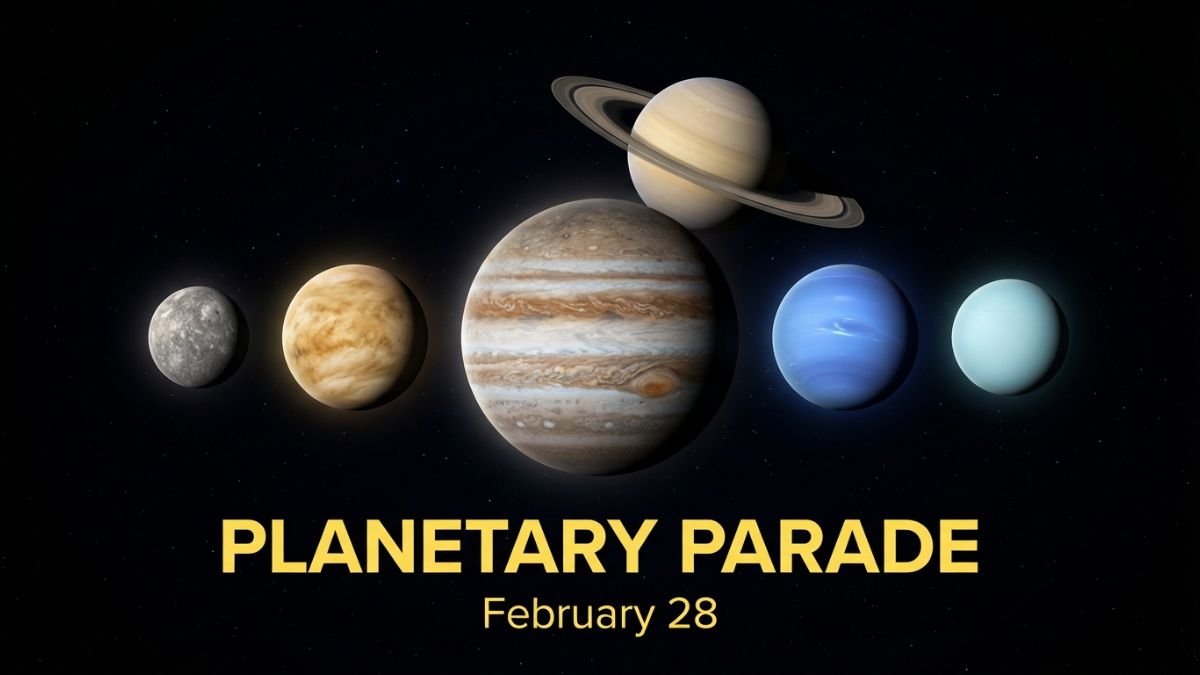
The month of February 2026 is a celebration for astronomy lovers and skywatchers. This month, a rare sight will be witnessed in the sky after sunset, when six planets will appear simultaneously. This special event is being called a “planetary parade.” Usually, two or three planets are visible in the evening, but this time, six planets will be seen lined up in a row. This sight is expected to be best visible around February 28, 2026.
According to the space agency NASA, during this period, Mercury, Venus, Neptune, Saturn, Uranus, and Jupiter will appear in a specific order in the sky. These planets can be seen after sunset throughout the month of February, but their alignment will be most spectacular in the last days of the month.
Which planets will be visible?
If the weather is clear and the horizon is clear, four of the six planets can be seen with the naked eye. Of these, Venus, Mercury, Saturn, and Jupiter will be relatively easy targets. However, binoculars or a telescope will be required to view Uranus and Neptune, as they are quite distant and relatively faint.
Sometimes, viewing Mercury can also be challenging, as it appears very close to the Sun and sets quickly. Therefore, the right timing and clear skies are essential.
Why is it difficult to view planets?
According to NASA, it is best to view a planet at least 10 degrees above the horizon to view it without instruments. Earth’s lower atmosphere blurs the light of celestial bodies during sunset and sunrise.
When a planet is very close to the horizon, its light is scattered in the atmosphere and cannot reach the eye clearly. Furthermore, obstructions such as buildings, trees, or mountains can also obstruct the view. This is why it is sometimes difficult to view planets immediately after sunset.
Best Time and Method
According to the astronomy website Space.com, it’s best to look west about 30 minutes after sunset on February 28th. It’s best to have clear weather, an open horizon, and, if possible, binoculars or a telescope.
Venus and Mercury will be closest to the horizon, followed by Saturn and Neptune. Uranus and Jupiter will appear relatively high. Because some planets will be very close to the sun, viewing time will be limited. It’s possible that seeing more than three planets at the same time can be challenging.
How rare is this event?
According to NASA, at least one bright planet can be seen almost every night in clear weather. Two or three planets are also common. However, a clear view of four or five planets together occurs only once in a few years.
Mars, Jupiter, and Saturn are often visible in the night sky. But when Venus and Mercury also join them, the alignment becomes special. Venus and Mercury orbit much closer to the Sun, and their orbits are shorter and faster than Earth’s.
Venus, when at its greatest distance from the Sun, appears brightest in the evening or morning for a few months. Mercury, which orbits the Sun in just 88 days, is typically visible for only two weeks or less, around sunset or sunrise.
When will you get such a chance next?
If you miss this rare planetary parade in February 2026, the next big opportunity will come in late October 2028, when the five planets will be visible together before sunrise. After that, the five planets will again be visible after sunset in late February 2034, although Venus and Mercury will not be easily visible even then.
Conclusion
This six-planet alignment in February 2026 could prove to be a wonderful experience for astronomy lovers. Clear skies, the right timing, and a little patience will be the keys to witnessing this rare spectacle.
This event reminds us that the universe is constantly in motion and periodically presents us with opportunities to peer beyond our Earth and marvel at the beauty of the solar system. Weather permitting, gaze up at the western sky on the evening of February 28th—you might just witness a unique parade of six planets simultaneously.
FAQs
Q. When will the six-planet alignment be best visible?
A. It will be best visible shortly after sunset on February 28, 2026.
Q. Which planets are part of this alignment?
A. Mercury, Venus, Neptune, Saturn, Uranus, and Jupiter.
Q. Can all six planets be seen without a telescope?
A. No, only four may be visible to the naked eye; Uranus and Neptune require binoculars or a telescope.
Q. Where should I look to see the planetary parade?
A. Look toward the western horizon about 30 minutes after sunset.
Q. How rare is this event?
A. Seeing four or more planets aligned visibly happens only every few years, making this a special sky event.